Under acute stress, the brain frequently relies on cognitive shortcuts known as cognitive distortions. Common distortions include all-or-nothing thinking, catastrophizing, and emotional reasoning. Left unexamined, these automatic negative thoughts drive emotional distress.
This educational guide examines the neuroscience of prefrontal regulation, Cognitive Behavioral Therapy (CBT) reframing steps, common distortions, and interactive tools.
1. What is Cognitive Reframing?
Cognitive reframing is a foundational technique in Cognitive Behavioral Therapy that involves identifying unhelpful automatic thoughts, evaluating the evidence for and against them, and formulating a balanced perspective.
2. Neuroscience of Prefrontal Regulation
During emotional distress, the amygdala signals acute threat. Engaging prefrontal cortical networks through structured reframing downregulates amygdala reactivity and builds resilient neural pathways.
What the research shows: Clinical trials published in Behaviour Research and Therapy confirmed that cognitive reframing significantly reduces depressive rumination and anxiety by strengthening prefrontal cognitive control over limbic structures (Beck et al., 2011).
3. Step-by-Step Reframing Protocol
To practice cognitive reframing:
- Catch the automatic thought: Notice what you are saying to yourself during distress.
- Identify the distortion: Ask if the thought is catastrophizing or all-or-nothing thinking.
- Examine objective evidence: List the verifiable facts for and against the thought.
- Formulate a balanced reframe: Write or state an adaptive, realistic perspective.
4. Benefits Supported by Research
Cognitive reframing improves stress resilience, prevents depressive relapse, and cultivates realistic problem-solving.
5. Limitations and Considerations
Reframing is not toxic positivity. It does not ignore real adversity; rather, it ensures you view situations clearly without catastrophic exaggeration.
6. Different Ways to Practice
Practice modalities include:
- Thought records: Structured CBT journal worksheets.
- Guided dialogue: Working alongside a qualified therapist.
- Interactive cognitive games: Visual tools that guide step-by-step untangling.
7. Where Interactive Tools & Ponoki Fit
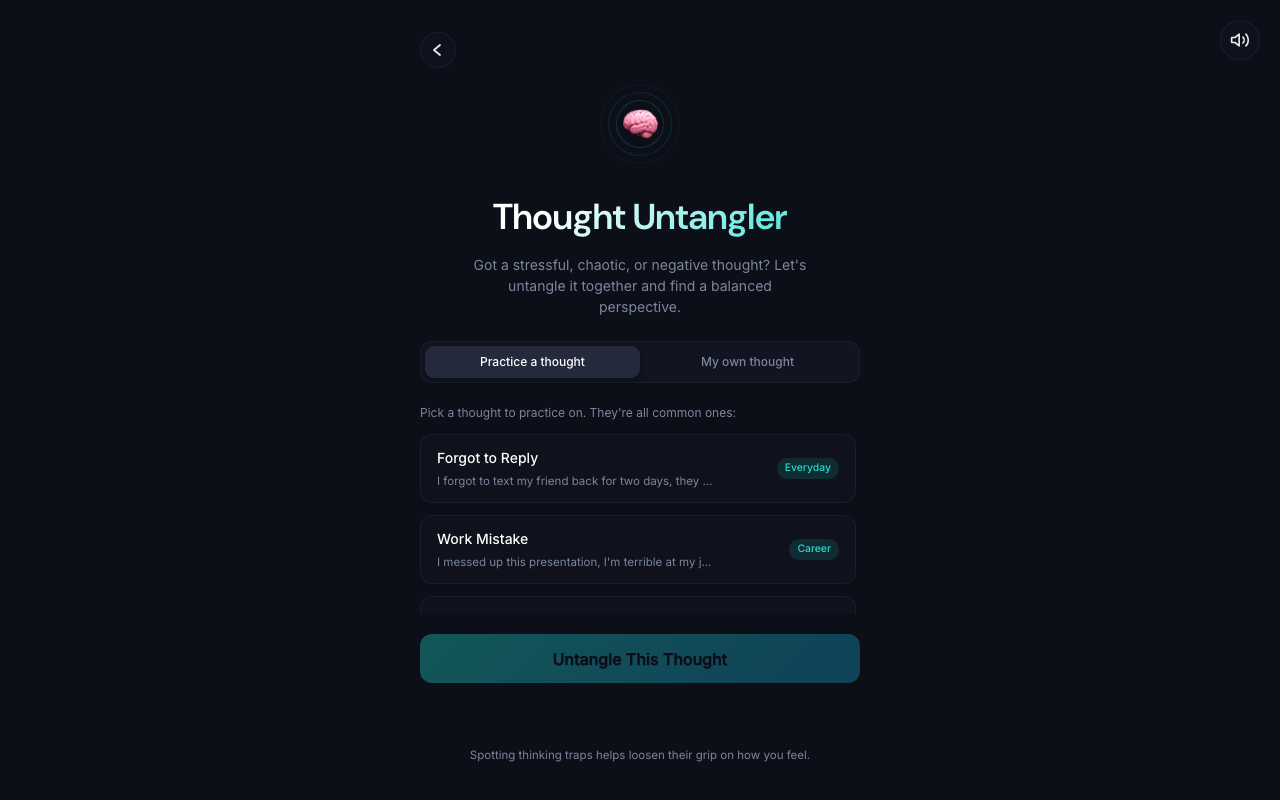
To make CBT reframing accessible and visually engaging, Ponoki offers Thought Untangler.
In Thought Untangler, users visually separate tangled thought nodes, categorizing distortions and revealing balanced cognitive reframes step by step.
8. External Scientific References
- Beck, J. S. (2011). Cognitive Behavior Therapy: Basics and Beyond. Guilford Press. View CBT Efficacy Review
9. Frequently Asked Questions
What is cognitive reframing?
Cognitive reframing is a psychological technique within Cognitive Behavioral Therapy that involves identifying automatic negative thoughts and replacing them with balanced, evidence-based interpretations.
Does cognitive reframing mean ignoring real problems?
No. Cognitive reframing is not toxic positivity; it examines the objective facts of a situation without catastrophic exaggerations.