When individuals say they feel "bad" or "overwhelmed," the lack of emotional specificity leaves the amygdala in a state of alert. Affect labeling (the practice of putting precise linguistic words to emotional experiences) engages inhibitory pathways between the prefrontal cortex and the amygdala.
This educational guide examines emotional granularity, prefrontal down-regulation, practical labeling vocabulary, and interactive selection wheels.
1. What is Affect Labeling & Emotional Granularity?
Affect labeling is the explicit assignment of linguistic descriptors to emotional states. Emotional granularity refers to the precision of these distinctions (for example, identifying whether you are feeling neglected, disappointed, or overstimulated rather than simply "upset").
2. Neuroscience of Amygdala Down-Regulation
Functional MRI research demonstrates that when individuals verbalize emotional states, activation in the right ventrolateral prefrontal cortex (rVLPFC) increases significantly while amygdala firing decreases.
What the research shows: Research published in Psychological Science demonstrated that putting feelings into words rapidly dampens amygdala activation via prefrontal inhibitory signaling (Lieberman et al., UCLA, 2007).
3. Step-by-Step Practice Instructions
To practice affect labeling:
- Pause before reacting: Take a quiet breath when distress occurs.
- Scan primary feelings: Ask if the emotion falls under fear, anger, sadness, or exhaustion.
- Find precise vocabulary: Narrow down to the exact descriptive term.
- State the label clearly: Say mentally or aloud, "I am feeling unappreciated right now."
4. Benefits Supported by Research
Higher emotional granularity is associated with lower anxiety severity, reduced stress-related physical symptoms, and better interpersonal communication.
5. Limitations and Considerations
Labeling an emotion does not make a challenging circumstance disappear, but it restores the executive capacity needed to respond effectively.
6. Different Ways to Practice
Individuals practice affect labeling through:
- Emotion wheels: Physical printed vocabulary charts.
- Reflective journaling: Writing daily emotion entries.
- Interactive selection tools: Applications that guide users through emotional granularity trees.
7. Where Interactive Tools & Ponoki Fit
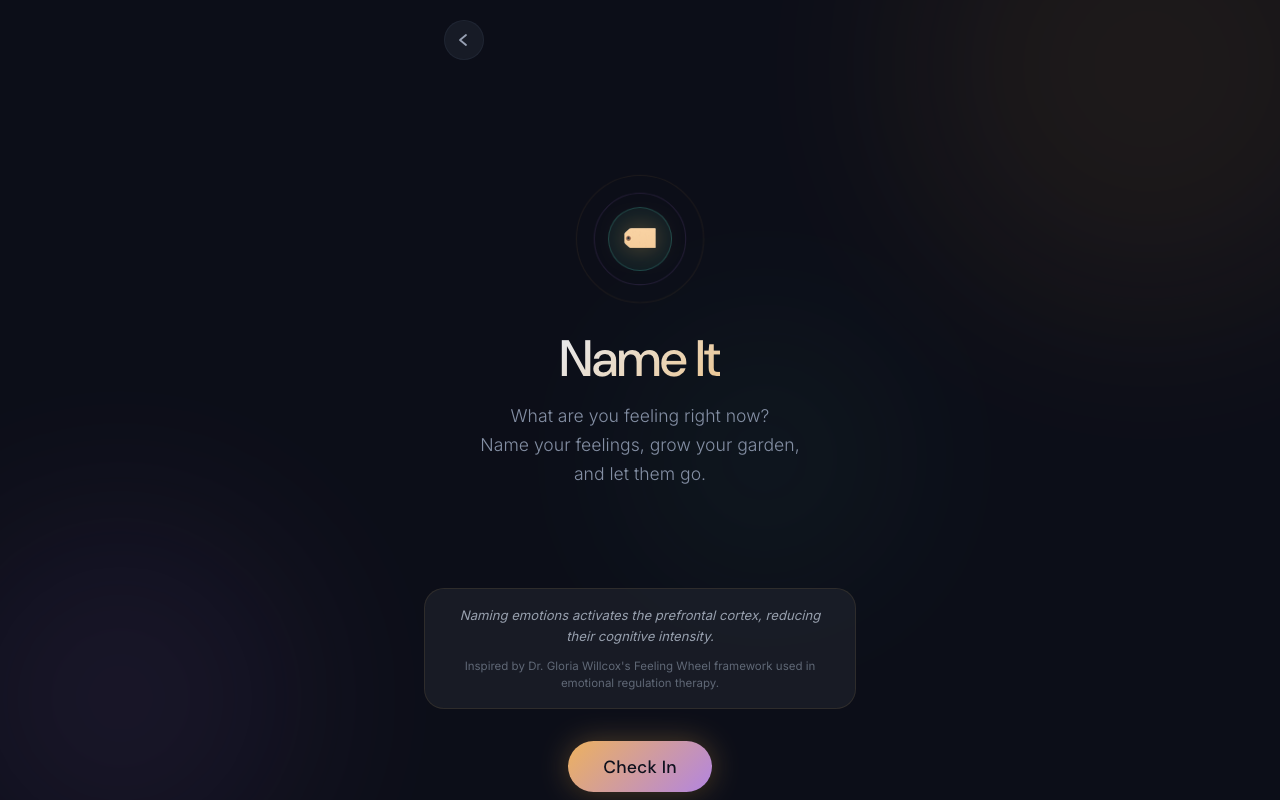
To help users explore nuanced emotional vocabulary without judgment, Ponoki offers Name It.
Name It gently guides users through an interactive vocabulary tree, helping them translate diffuse feelings of overwhelm into precise, validating affect labels.
8. External Scientific References
- Lieberman, M. D., et al. (2007). Putting feelings into words: affect labeling disrupts amygdala activity in response to affective stimuli. Psychological Science, 18(5), 421-428. View Study on PubMed
9. Frequently Asked Questions
What is emotional granularity?
Emotional granularity is an individual's ability to differentiate between specific, nuanced affective states rather than using broad terms like 'bad' or 'upset'.
Why does putting feelings into words calm the nervous system?
Verbalizing emotional states engages the right ventrolateral prefrontal cortex, which sends inhibitory neural projections to downregulate amygdala firing.