Cognitive rumination involves repetitive, unproductive dwelling on negative emotions or past distress. Because rumination is maintained by Default Mode Network (DMN) hyper-connectivity, direct willpower rarely breaks the cycle. Engaging visual-spatial processing diverts neural resources away from rumination.
This educational guide examines the neuroscience of DMN activity, attentional diversion, pattern tracing, and calming spatial games.
1. What is Cognitive Rumination?
Rumination is repetitive cognitive looping around distressing thoughts without active problem-solving. It is a common symptom in anxiety, depression, and ADHD emotional dysregulation.
2. Neuroscience of the Default Mode Network (DMN)
The Default Mode Network (including the posterior cingulate cortex and medial prefrontal cortex) becomes highly active during self-referential rumination. Engaging the Task-Positive Network (TPN) through structured visual-spatial tasks down-regulates DMN activity.
What the research shows: Neuroimaging research published in Proceedings of the National Academy of Sciences (PNAS) demonstrated that engaging in structured visual-spatial tasks rapidly deactivates Default Mode Network rumination loops (Brewer et al., 2011).
3. Step-by-Step Practice Instructions
To interrupt cognitive rumination:
- Notice the repetitive loop: Acknowledge that your mind is stuck in a circular worry pattern.
- Shift to visual-spatial tracing: Trace an external geometric shape or star constellation with your eyes or finger.
- Connect nodes gently: Let your attention absorb the sensory feedback of completing patterns.
4. Benefits Supported by Research
Visual-spatial diversion stops circular rumination, lowers evening mental chatter, and facilitates restful transition before sleep.
5. Limitations and Considerations
Tracing tasks are helpful for interrupting acute rumination loops, but if the loops are constant or overwhelming, a good therapist can help far more than any app, often with approaches like Cognitive Behavioral Therapy.
6. Different Ways to Practice
Individuals break rumination loops through:
- Physical pattern drawing: Mandalas, geometric sketches, or labyrinth tracing.
- Puzzle games: Low-stakes spatial arrangement puzzles.
- Constellation tracing: Digital experiences that guide gentle point-to-point connections.
7. Where Interactive Tools & Ponoki Fit
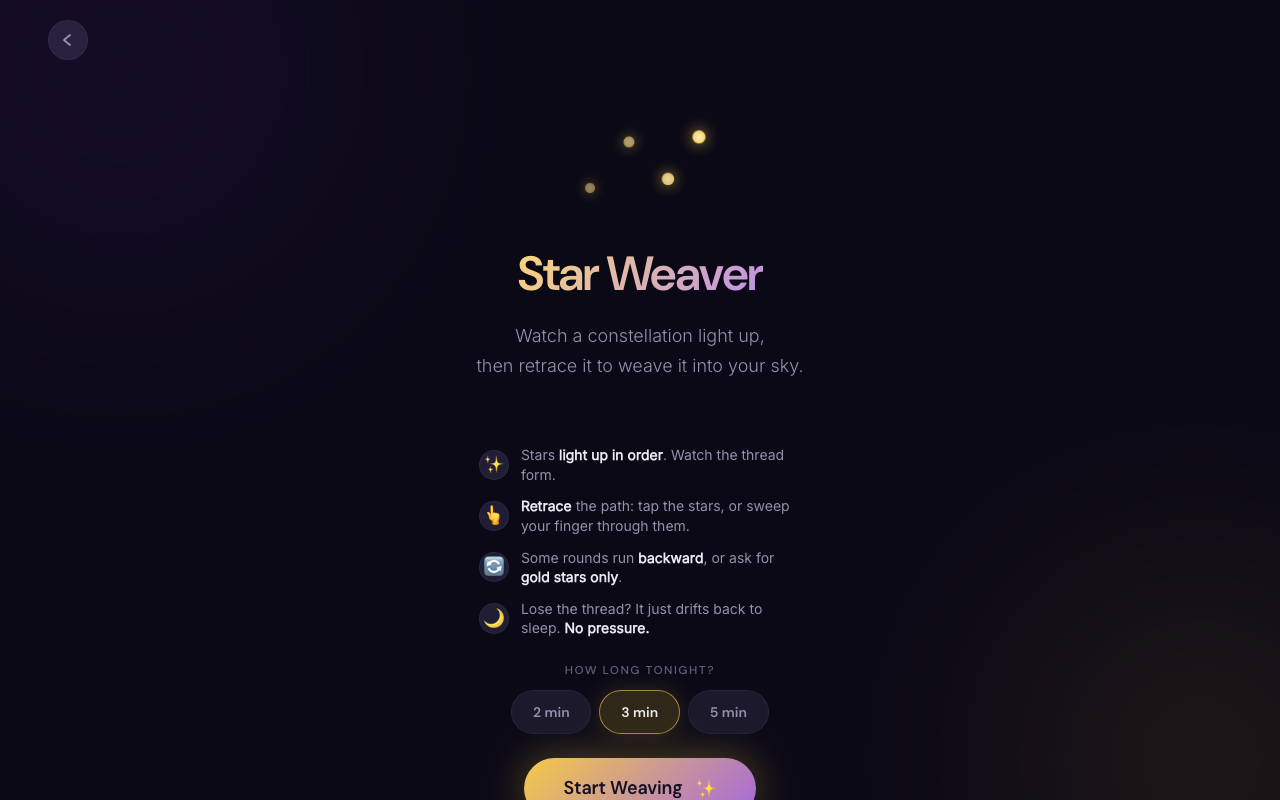
To provide a calm visual-spatial tracing experience, Ponoki offers Star Weaver.
In Star Weaver, users connect glowing celestial nodes to reveal soothing constellations. By engaging the brain's visual-spatial processing centers, Star Weaver gently interrupts repetitive rumination loops.
8. External Scientific References
- Brewer, J. A., et al. (2011). Meditation experience is associated with differences in default mode network activity and connectivity. PNAS, 108(50), 20254-20259. View Study on PubMed
9. Frequently Asked Questions
Why is it difficult to stop rumination by willpower alone?
Attempting to suppress repetitive thoughts activates the Default Mode Network, which reinforces the self-referential loop. Engaging visual-spatial processing diverts attention naturally.
What is the Default Mode Network (DMN)?
The Default Mode Network is an interconnected group of brain regions active when a person is not engaged in an external task, frequently driving self-referential worry.